Boundary Layer Research Index
A comprehensive archive of peer-reviewed publications, conference proceedings, and computational fluid dynamics studies examining microclimate interactions within utility-scale solar arrays.
03
05
2D/3D
Peer-reviewed journal articles in high-impact fluid dynamics and solar energy publications.
Conference papers and technical presentations delivered at international symposia.
Computational models simulating boundary layer turbulence across complex terrains.
Peer-Reviewed Literature
Published research analyzing the fluid-structure interactions, convective heat transfer, and atmospheric boundary layer dynamics of utility-scale solar installations.
Convective Heat Transfer in Canopies
An analytical framework modeling boundary layer turbulence and thermal dissipation across dense solar PV arrays under varying wind shear conditions.
Wind Loads on Solar Arrays
Experimental and computational assessment of shear stress distribution and wake propagation behind multi-row utility-scale photovoltaic tracking systems.
Microclimate Dynamics of Large Arrays
Investigating the vertical transport of momentum and heat within the surface layer, utilizing high-resolution large-eddy simulations.
Selected Conference Proceedings
ASME International Mechanical Engineering Congress (2023) — Modeling wake interactions in complex terrain solar installations.
American Physical Society Division of Fluid Dynamics (2022) — Turbulence intensity effects on photovoltaic convective cooling.
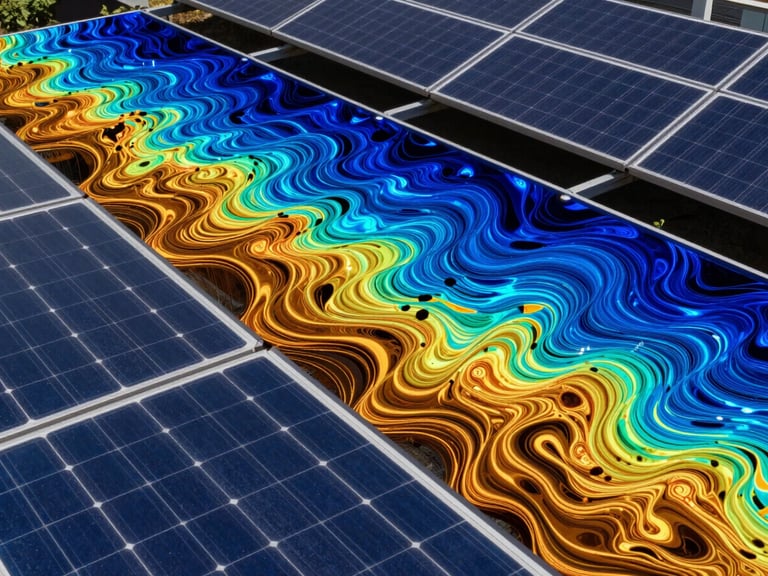
Fluid Dynamics Modeling
Our methodology bridges high-fidelity large-eddy simulations with empirical wind tunnel validation to map microclimate behavior.
Mathematical Modeling
By simulating the atmospheric boundary layer at high spatial resolution, we capture the precise shear stresses and thermal plumes that dictate panel efficiency and structural fatigue.
This predictive modeling allows developers to optimize array spacing and tracking algorithms, directly mitigating wind-induced structural failures.