

Fluid Dynamics of Utility Scale Solar Farm
I am a graduate research assistant in the Mechanical Engineering department at the University of Utah, where my work focuses on understanding how large-scale solar farms interact with the atmosphere they're immersed in. As solar photovoltaic (PV) capacity expands to meet a growing share of global electricity demand — IRENA projects solar could supply roughly a quarter of global electricity by mid-century, while the U.S. DOE's Solar Futures Study points to as much as 45% of U.S. electricity by 2050 — the footprint of solar farms is growing just as fast, with installations spanning hundreds of acres. These panels don't sit passively on the landscape; they act as a new class of surface roughness, altering wind and heat transport much like trees or buildings. Because they're elevated above the ground rather than attached to it, this behavior is classified as "e-type" roughness, analogous to the traditional d-type and k-type roughness studied in atmospheric boundary-layer research.Using Large Eddy Simulation (LES) through the Uintah MPMICE fluid–structure interaction platform, I investigate turbulent flow over solar arrays in both heated and non-heated configurations, quantifying key aerodynamic properties — equivalent roughness length, displacement height, array drag, and the role of the under-panel gap — to understand how array geometry governs momentum and heat exchange with the atmosphere. This work informs wind-load and structural safety, more efficient row spacing and mounting design, and better predictions of how solar farms affect local microclimates, as solar deployment scales up in the coming decades.
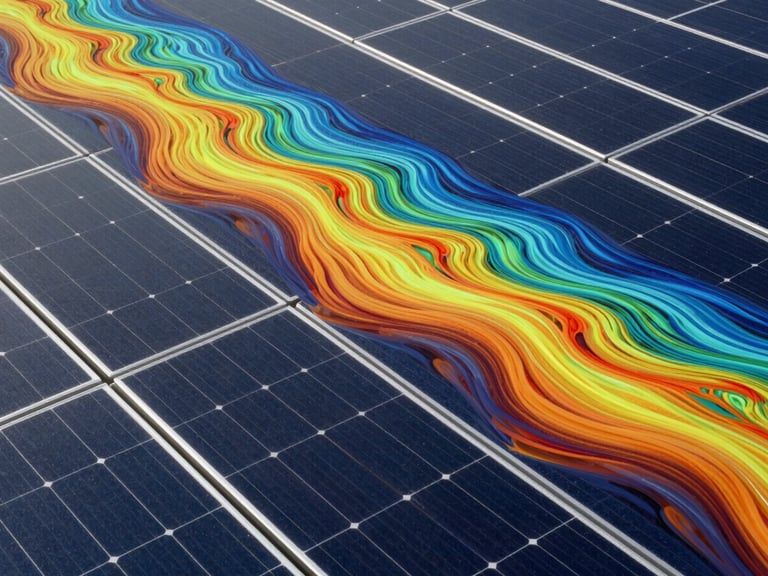
The Boundary Layer
We bridge computational fluid dynamics with empirical wind tunnel data. By simulating micro-climate turbulence, we prevent structural fatigue and optimize solar energy capture under complex atmospheric conditions.
Research Pillars
CFD Simulations
Empirical Validation
Open Science
High-fidelity modeling of atmospheric turbulence across utility-scale arrays using high-performance computing clusters.
Publishing reproducible workflows, Python analysis pipelines, and raw simulation datasets for the wider academic community.
Comparing numerical models against physical boundary layer wind tunnel experiments to ensure absolute precision.
Academic Collaboration
Seeking postdoctoral opportunities and R&D partnerships to translate fluid dynamics research into utility-scale solar efficiency.